


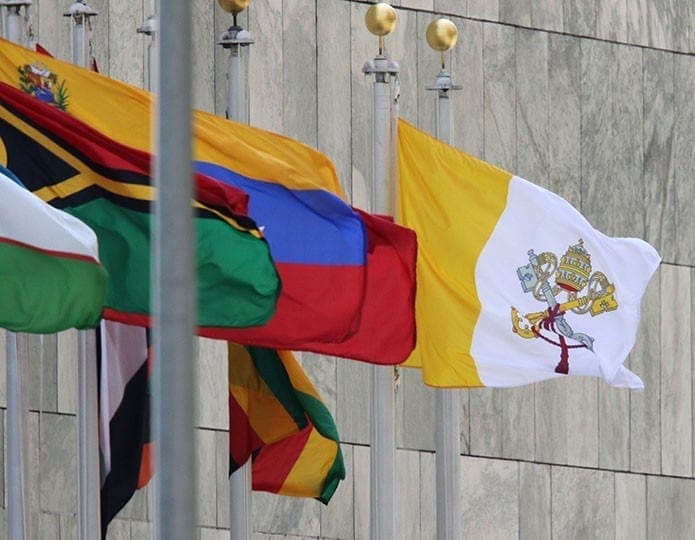
 CNS photo/Bob Roller
 United Nations
People come first, human life is sacred, pope insists at U.N.
By CINDY WOODEN, Catholic News Service | Published September 25, 2015
UNITED NATIONS (CNS)—Dealing with war, development, the economy or environmental concerns, bureaucrats and diplomats always must remember that the lives of real children, women and men are at stake, Pope Francis told the United Nations.
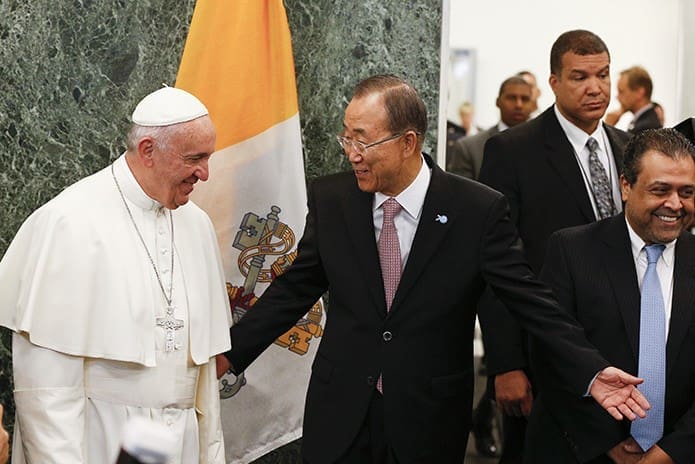
U.N. Secretary-General Ban Ki-moon welcomes Pope Francis to the United Nations headquarters in New York Sept. 25. CNS Photo/Paul Haring
Helping to celebrate the organization’s 70th anniversary, Pope Francis visited its headquarters Sept. 25 and pleaded with government leaders and U.N. officials to keep the dignity and sacredness of every human life and the value of all creatures at the center of their concern.
“Above and beyond our plans and programs,” he told the U.N. General Assembly, “we are dealing with real men and women who live, struggle and suffer and are often forced to live in great poverty, deprived of all rights.”
More than 190 heads of state were attending the General Assembly, and many of them made a point of being in the U.N.’s historic hall for Pope Francis’ speech on the eve of discussion of the 2030 Agenda for Sustainable Development and, later in the year, the Paris Conference on Climate Change.
The first hour of Pope Francis’ visit was heavy on protocol and posing for official group photographs. He met privately with U.N. Secretary-General Ban Ki-moon and spoke briefly with U.N. employees, urging them to make their workplace a model of the peace and respect they work to promote around the world. He also paid tribute to the sacrifice of U.N. employees killed in the line of duty.
Pontiff calls for action to support human life
Pope Francis called for real, concrete action to stem climate change; respect for every human life and for “the natural difference between man and woman”; economic decisions that place the needs of people before profits; and greater controls on weapons sales and the elimination of nuclear weapons.
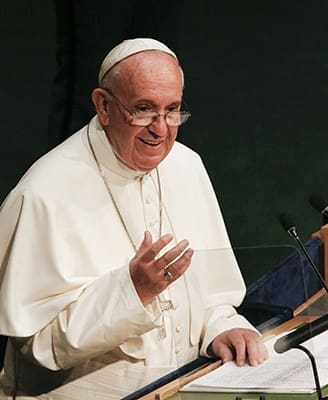
Pope Francis addresses the General Assembly of the United Nations in New York Sept. 25. CNS Photo/Bob Roller
He praised recent international agreements with Iran to ensure it does not develop nuclear weapons and he pleaded for real, concrete, multilateral efforts to bring peace and justice to the Middle East, North Africa and other African countries plagued by the violence of extremists claiming to act in the name of Islam.
“Christians, together with other cultural or ethnic groups and even members of the majority religion who have no desire to be caught up in hatred and folly,” he said, “have been forced to witness the destruction of their places of worship, their cultural and religious heritage, their houses and property, and have faced the alternative either of fleeing or of paying for their adhesion to good and to peace by their own lives or by enslavement.”
Those lives, he said, “take precedence over partisan interests.”
“In wars and conflicts there are individual persons—our brothers and sisters, men and women, young and old, boys and girls—who weep, suffer and die,” the pope said. They are treated as “human beings who are easily discarded when our only response is to draw up lists of problems, strategies and disagreements.”
Pope Francis warned the U.N. leaders and the heads of state that too many decisions seemed to be based on the desire by a few for economic or political power, ignoring the values and rights the United Nations was formed to promote and protect.
The United Nations, he said, is called to help humanity “dispel the darkness of disorder caused by unrestrained ambitions and collective forms of selfishness.”
“Economic and social exclusion is a complete denial of human fraternity and a grave offense against human rights and the environment,” the pope said, echoing one of the main themes of his encyclical, “Laudato Si’.” The document emphasized that respect for creation must include respect for all creatures, human beings included, and that efforts to reduce poverty and promote development must respect both the earth and the people who live there.
Freedom a recurring theme
The best way to measure the success of the new development goals, he said, will be how they give “effective, practical and immediate access, on the part of all, to essential material and spiritual goods: housing; dignified and properly remunerated employment; adequate food and drinking water; religious freedom and, more generally, spiritual freedom and education.”
“These pillars of integral human development,” Pope Francis said, “have a common foundation, which is the right to life and, more generally, what we could call the right to existence of human nature itself.”
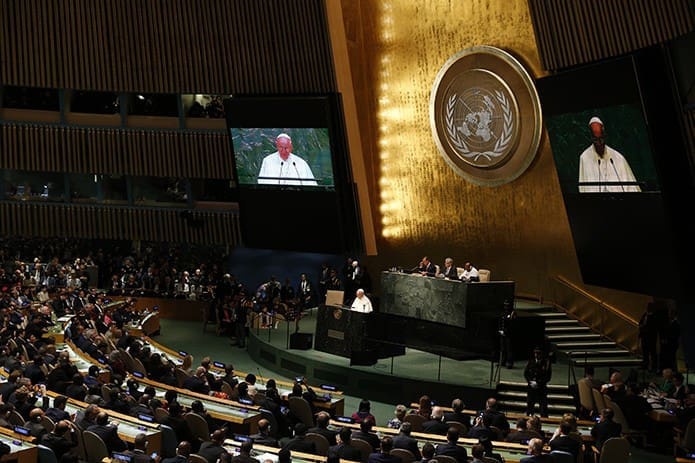
The hall of the General Assembly of the United Nations in New York is filled as Pope Francis speaks Sept. 25. CNS Photo/Paul Haring
Pope Francis insisted on the reality of “natural law,” an ethical code of right and wrong that all people can recognize. As he has done before, he condemned “an ideological colonization,” through which wealthier nations try to impose on poor countries not just a legitimate accounting of how aid is used, but also the imposition of “anomalous models and lifestyles which are alien to people’s identity.”
In the past, Pope Francis has termed as “ideological colonization” making development aid dependent on greater acceptance of homosexuality and gay marriage.
The earth, “the common home of all men and women must also be built on the understanding of a certain sacredness of creature nature,” the pope told the assembly.
While some people continue to question scientific evidence that human activity is contributing to global climate change, Pope Francis insisted “a true ‘right of the environment’“ exists and is closely tied to human rights, since people are part of nature and are called to live in communion with it.
“Any harm done to the environment,” he said, “is harm done to humanity.”