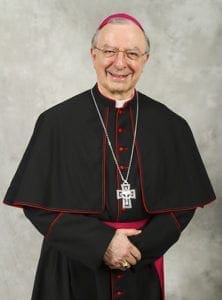
| By Suzanne Haugh
Staff Writer
ATLANTAParticipating in the sacrament of penance cleans the closets of
our beingmind, body and spirit. Our sins are boxed up and delivered to
the Father, and there is no return address needed. We are left feeling light,
clean and free. We have returned to a state of grace via the Holy Spirit.
The Holy Spirit is the master of interior life who offers us
grace, its first and foremost gift (Catechism of the Catholic
Church, 1995; 2003).
Grace is the presence of the Spirit within us, said Father Tom
Stegman, SJ, a doctoral student at Emory University. ... God is not
stingy. Gods grace is available to all. The beauty of the sacraments is
that they make as tangible as possible the conferral of Gods love for
us.
Father Stegman explained the gift of the sacraments, in which God
communicates to us through his Son, Jesus, as a parent does to a child using
simple language she or he can understand.
(Sacraments) activate grace, he said.
The sacrament of penance captures again for us the grace of justification,
or being dead to sin and alive to God through Jesus Christ (Romans
6: 8-11).
When we confess to a priest, we confess to the church and to God and
the priest makes tangible the words of forgiveness. We all know the feeling of
being unburdened afterwards.
The Catechism speaks of sanctifying grace, received at our baptism,
infused by the Holy Spirit into our soul to heal it of sin and to
create a disposition that perfects the soul itself to enable it to live
with God, to act by his love (Catechism of the Catholic Church, 1995;
1999-2000).
Sanctifying grace is the grace that says, If I die now then
Ill go to heaven, said Father Jack Durkin, parochial vicar at
St. John Neumann Church, Lilburn. Youre in a state of grace if
youre reconciled with the church.
The sacrament of penance is a gift to the churchits not an
obstacleit produces grace, he said.
And the gift of grace demands mans free response, the
Catechism instructs. Created in Gods image with the capacity to know and
love him, man must enter freely into the communion of love ... (and
longs) for truth and goodness that only God can satisfy (Catechism of the
Catholic Church, 2002).
Sanctifying grace is the life of a Christian, Father Durkin
said. Its life in the Spirit. And this means you have a
relationship with Jesus. Youre responding to God. Hes pouring out
these gracious gifts upon you and youre living in love, youre
living in joy ... For a Christian, nothing can conquer you, neither suffering
nor death.
The sacrament of penance strengthens ones resolve to respond to God
and, in doing so, one becomes a witness to those around him on the effects of
the sacrament.
The mark of a reconciled person is to become more reconciling in
turn, Father Stegman said. To me, one of the questions for
Catholics and non-Catholics alike is the efficacy of the sacramentshow
effective are they? From one vantage point, grace cannot be quantified, ...
(But one) can tell a tree by the fruit it bears ... A persons
orientation, attitudes, dispositionhis basic mode or
fruitsreveal the character within.
The fruits of the Spirit manifest themselves in the lives of the saints and
people like Mother Teresa and Pope John Paul II. In looking at their lives one
can come to understand and appreciate the workings of grace. Pope John Paul II,
who has made reconciliation a key theme throughout this Jubilee year,
exemplifies grace in action.
Is the Pope joyful? Father Durkin asked. Hes been in
a concentration camp. Hes been shot. He knows all the troubles of the
church and has been involved in all the great crises of the world, and is he
joyful? Yes! How can that be? The man should be exhausted. He should be retired
and puttering around a golf course. But hes going harder and harder every
day. Wheres that coming from? Praise God ... Hes hard not to
love.
Through Christs disciples, both past and present, one sees the give-
and-take between self-sacrifice and the gift of nurturing grace, all for a
share in eternal life. But how does one reach the general population and move
them to accept that the sacrifices today are worth the future gain of eternity?
Things will never satisfy us, Father Durkin said. The
Beatles sing, All You Need Is Love. Who in this world would say
that love is not what its all about? People will deny the truth and
everything else but when it comes down to love, almost everyone is for
love.
To truly love and be loved is a decision that requires Gods grace for
support. Often times, it is difficult and not always what the world markets as
cool, hip or successful.
We honor veterans on Veterans Day because of love of country. They
died; they know what sacrifice is. We know theres a cost to love,
Father Durkin said. So what were saying is we have a God and
our God is defined by love. And our God is so loving that they are three
persons who totally give themselves to each other and fully receive each other
back ... Were made to imitate that, which is to totally give ourselves to
others so that we actually find out who we are, and what we are is love.
Were either that or a nothing.
The marketing (of eternity) to the world is that we know we
arent defined by what we have but by who we are, Father Durkin
said. Youre a lover or youre not a lover. And we know that
people who are not lovers are diminishedalmost everyone can see
that.
Some people will never get beyond the pull of worldly desires. They
just need more and more, but someday they die and it wont really mean
anything, Father Durkin said.
Father Durkin compared the dissatisfaction of those who rely too much on
material wealth to the happiness of those whose lives are rich in the Spirit.
The whole problem is that people are just trying to run away, he
said. Theyve got this giant house. Its empty; theres
nobody in it. Theyve got their crystal. Theyre in their gated
community. Theyve got everything, but what are they? Totally unhappy ...
And here Mother Teresa was, in the totally ungated community of Calcutta, and
no matter what she saw she could still love somebody, whether he was a leper or
a diseased person not of our faith ... How could Mother Teresa be joyful? She
was around a bunch of sick people. Why are her sisters happy? They dont
have anything. Theyre not going to get married and people around them are
dying. Its a complete antithesis to the world ... Theres no reason
to be joyful when youre looking at a person by the side of the street
with maggots crawling on him unless God is there and says, He is made in
my image and likeness. Feed me because I am suffering.
Mother Teresa was, and her sisters continue to be, like many others, Christ
among us, Father Durkin said.
Theyre responding to the grace of the Holy Spirit poured out by
Christ. He didnt say, youre just going to carry on my
mission. He said, you will do greater things than I
through the gifts of the Holy Spirit.
That comes through a relationship with Jesus, and is the beginning point of
returning to a state of grace and leading a life of true Christian
discipleship.
The relationship always is, of course, that he loves us first,
Father Durkin said. Do I respond to his love? Do I embrace the cross of
my suffering? Theres no love without sacrifice. The relationship is
I give up myself totallymind, heart, bodyto somebody
else. Were always defined by our conformity to the image of God,
and God has been defined as a totally self-sacrificing person.
Love of self comes first: honestly discovering ones unique identity
and conforming oneself to the truth.
Human beings, each one, are created in Gods image, Father
Stegman said. ... We all believe this with our heads, but think of its
ramifications. We understand that in each one of usin our particular
ways, particular talents, the circumstances of our lives, in the relationships
that we haveeach of us is capable of reflecting, through our own being, a
unique aspect of Gods goodness. God gives life. He redeems and creates.
Not that we create and redeem, but we cooperate in his work as stewards of
creation ... This is true of every person.
Father Durkin explained the connection between love of self and
discipleship.
To love yourself, the cost is to be free from your sins ... So you can
totally give yourself to something else. Thats why the identification of
sin is a gift, a gift of the Holy Spirit. You have judgment and know what to do
... It leads you to deeper waters.
As distinct persons of mind, heart and body, we are made for communion,
offering ourselves to others.
You either do that in the married state, saying, I offer myself
to this other person exclusively, or choose a life of
celibacy, (saying,) I offer myself to the community.
Its a total self-offering.
Ironically, by giving up ourselves we discover and become who we truly are.
But sin detracts from ones gift and Satan cleverly uses good things
to tempt us, Father Durkin said. He gave an example of how sex is often
portrayed and appreciated only in the context of bodily pleasure and not as a
gift that encompasses the mind and spirit as well.
Sex is good ... its sacramental ... its participation in
the creative act of God. But its good is diminished significantly when Satan
takes it and puts it in the wrong context.
Its the Holy Spirit who nudges us to reflect on the areas where
weve sinned.
The problem is grave sin, right? Father Durkin said. So
the question is When did I reach the point where grace wasnt
flowing?
Mitigating circumstances can lessen the severity of ones sins, but
forming ones conscience is an important step.
The starting point is I have to get rid of all sin. Ive
got to let Jesus in. How do I let him in? Well, there are Ten
Commandments. (Lets say,) I can obey eight of these fine, but two
of these I cant. I cant obey those without (Gods help)
... Thats good. We have a relationship. In other words, you pray, you
gotta pray.
The sacrament of penance wipes clean the buildup of sin.
People who go to confession accuse themselves of sin; they name their
sins, Father Durkin said. What is Satan? Hes the accuser. You
take power away from Satan when you say ... I am a sinner. I claim it.
Jesus died for me, and here are my sins, right here.
A spiritual person always sees things in relationship to being his
brothers and sisters keeper, Father Durkin said. When we fall short
of loving, we have somewhere to go to restore our spiritual health.
The effects of confession and the other sacraments support a life lived in
the state of grace. Father Stegman said, The sacraments in the life of
the church offer a way of perceiving. Its a direct way of thinking and
behaving and giving a lens through which to view God, others and ourselves.
Father Stegman views the act of confession not only as a time to ask for
pardon of ones sins, but also to share, as St. Augustine pointed out,
what Gods grace has done in ones life, as Mary does in the
Magnificat: My soul proclaims the greatness of the Lord and my spirit
exults in God my savior because he has looked upon his lowly handmaid ... Holy
is his name (Luke 1: 46-53).
Mary emptied herself to house the Savior. For us, uncluttered by sin through
the sacrament of penance, we have room to receive the graces of the Holy
Spirit, sent priority mail, same-day service: love, joy, peace, patience,
kindness, goodness, trustfulness, gentleness and self-control (Galatians
5: 22-26).
|