


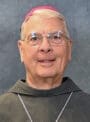
 Archbishop Gregory J. Hartmayer, OFM Conv., is the seventh Archbishop of Atlanta. In “Peace and All Good,” he shares pastoral reflections.
I am with you always: Reflections on the National Eucharistic Congress
By ARCHBISHOP GREGORY J. HARTMAYER, OFM Conv. | Published August 12, 2024 | En Español
Like many of you, I had the opportunity and privilege to attend the beautiful National Eucharistic Congress in Indianapolis in July.
To see more than 50,000 of the lay faithful, thousands of priests, over 150 bishops, thousands of consecrated women and men in distinctive religious habits, and hundreds of seminarians celebrating the Real Presence of Christ in the Blessed Eucharist was something to behold. Even prior to the National Eucharistic Congress, we witnessed so many beautiful expressions of faith and devotion in this local church as the Blessed Sacrament made its way, through towns and cities, farmland and rivers, on the St. Juan Diego route to Indianapolis.
One of the great highlights of Indianapolis was the procession of the Blessed Sacrament downtown, all united in worship and adoration of the King of Kings and Lord of Lords. And once the procession had ended, there was complete silence as everyone knelt in prayer in preparation for Benediction. The love, devotion, reverence and zeal I witnessed over those blessed days will remain with me forever.
Then, a few days later, in Paris, France, the most sacred of all banquets—the Last Supper—was mocked and ridiculed on the world stage at the opening ceremony of the Olympics in an act of blasphemy. What followed were excuses stating that it wasn’t meant to be offensive to Christians; others said it was only a representation of the Greek god Dionysius. However, such ridicule is nothing new. We recall the fact that many followers of Jesus left him when he preached about the Eucharist. For us who believe, the Eucharist is the Body and Blood, soul and divinity of Jesus Christ.
In a homily at World Youth Day in Denver in 1993, Pope St. John Paul II said: “Do not be afraid to go out on the streets and into public places, like the first Apostles who preached Christ and the Good News of salvation in the squares of cities, towns and villages. This is no time to be ashamed of the Gospel. It is the time to preach it from the rooftops. Do not be afraid to break out of comfortable and routine modes of living, in order to take up the challenge of making Christ known in the modern ‘metropolis.’ It is you who must ‘go out into the by-roads’ and invite everyone you meet to the banquet which God has prepared for his people. The Gospel must not be kept hidden because of fear or indifference. It was never meant to be hidden away in private. It has to be put on a stand so that people may see its light and give praise to our heavenly Father.”

Pilgrims head into Lucas Oil Stadium for the National Eucharistic congress. Photo by Andy Lichtenwalner
Surely, in the months leading up to the National Eucharistic Congress and at the Congress itself, we saw the Holy Father’s challenge embraced wholeheartedly.
While the National Eucharistic Congress was truly a remarkable celebration of faith and Catholics of all ages felt revitalized in their faith, this eucharistic renewal did not end in Indianapolis. The challenge of Pope St. John Paul II remains the same and is even more urgent today than when he spoke those words in 1993. Our Catholic faith continues to be mocked and ridiculed in the public square. The church’s teachings are challenged both from within and from the outside.
But we should not be discouraged, nor should we be afraid. The Lord is with us. In his own words: “I am with you always!” He is true to his promise. We must continue this revival in our homes and communities, in our parishes and in our schools. Not only are we called to a frequent and fervent reception of our Lord in the Eucharist at Mass, but we need to come to him in prayer before the tabernacle and the monstrance, to allow his heart to speak to ours.
We are challenged to live out the Eucharist by serving the poor and the needy, as well as defending life in all its stages, from its beginning to natural death. We should be ready to give an account of what we believe through our prayerful study of the Scriptures and spiritual readings.
In a meeting with the organizers of the National Eucharistic Congress, Pope Francis stated: “It is my hope, that the Eucharistic Congress will inspire Catholics throughout the country to discover anew the sense of wonder and awe at the Lord’s great gift of Himself … I cannot fail to mention the need for fostering vocations to the priesthood, for as Saint John Paul II said, ‘There can be no Eucharist without the priesthood.’”
We are blessed with so many dedicated priests in this local church and seminarians in formation. However, we know that we can never have enough priests. Vocations to the priesthood are born in the family, the “domestic church.” I ask that we all pray, especially within our families, for an increase of vocations to the priesthood. I pray that parents will encourage and support their children who are considering devoting their lives to the Lord’s service.
Once again, Pope Francis reminds us: “In the Eucharist, we encounter the One who gave everything for us, who sacrificed Himself in order to give us life, who loved us to the end. We become credible witnesses to the joy and transforming beauty of the Gospel only when we recognize that the love we celebrate in this sacrament cannot be kept to ourselves but demands to be shared with all.”