| By Rita McInerney
The dossiers of two married Episcopal clergymen who have requested
ordination as Roman Catholic priests have been submitted by the archdiocese of
Atlanta to the Vatican and are now under study by the Congregation for the
Doctrine of the Faith.
The clergymen are Father Thad Rudd and Father David Dye. Father Rudd was
rector of the Church of Our Saviour on North Highland Avenue, Atlanta. Father
Dye was assistant rector at St. Martin-in-the-Fields on Ashford Dunwoody Road,
Atlanta.
In the case of Father Rudd, a group of his parishioners, estimated to be 40
to 50 people, made the decision to seek admission to the Roman Catholic Church
with him. They have formed themselves as the Community of St. Augustine of
Canterbury and held the first service of evening prayer at All Saints Catholic
Church in Dunwoody on Sunday, Jan. 8. A parish reception to welcome them was
held the same evening.
Father Dye and his family have been received into the Catholic Church while
Father Rudd, his family and the group will enter together after a response is
received from Rome.
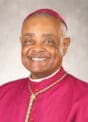
Archbishop Eugene A. Marino, S.S.J., is the sponsoring ordinary for both men
who sought to become Roman priests under the pastoral provision put
into effect by the Vatican for Anglican clergymen in 1980.
Archbishop Marino said he learned of the interest of the two clergymen
shortly after his installation last May 5. Both men had earlier communicated
their desire to Archbishop Thomas Donnellan. There was interest on his part,
but his illness and subsequent events prevented the cases from moving forward,
the archbishop said.
He was informed by Father Peter Ludden, chancellor, that both clergymen had
asked for appointments to see him, the archbishop continued. He met with each
of them during the summer.
I had no idea what the process was, had no first-hand
experience. I proceeded with interest, hope and caution. The caution, he
explained, was because of the extraordinary graciousness of Bishop
Charles J. Child, the Episcopal bishop of Atlanta, and the implications
for our own clergy and people.
Archbishop Marino said he wanted people to understand what was
happening when Episcopal priests, for reasons of faith and conscience, can no
longer continue their roles.
What people need to be acquainted with is the intolerable
burden placed on a man if he happens to be an Episcopal priest with a family
depending on him to function as a minister, and now, for reasons of conscience
and faith he has no alternative.
The church, he said, would be insensitive if it would not permit him
to act as a priest. It would seem that this would be an instance where the
Church could show insensitivity in not allowing a person in these circumstances
to be considered for and to be ordained.
The archbishop said Father Rudd would be admitted to the Church in a process
that would admit the group. They would become a Roman Catholic community with
an Episcopal identity and would be allowed special prayer at their Mass, the
prayer of the faithful, which would be closer to the Episcopal Church than to
the Roman Catholic Church.
Were not asking that they be brought in as a separate
parish, the archbishop said. A personal parish was not requested in the
dossiers submitted to the Holy See. All Saints will be the location for their
worship as Roman Catholics.
While there is usually a limit placed on the kind of assignment a priest can
be given under the pastoral provision, Archbishop Marino said a request for a
dispensation from such limitations had been made in the petition sent to Rome
for the two men.
Were sailing through uncharted waters. Im excited by the
possibilities, but at the same time dont have answers to all the
questions, the archbishop admitted.
He went on to say how moved he was when the group gathered, in October, at
his residence to present their petition to him. It showed a great deal of
faith on their part. They were taking a tremendous risk where there was no
guarantee that I would recommend their request or that the Holy See would act
on it.
He said he had talked to Cardinal Bernard Law several times concerning the
two applicants. The Boston prelate is in charge of the pastoral provision
applications from the United States.
He (Cardinal Law) felt the dossiers were very full and complete. There
were about 30 to 40 pages of documents, testimonies, the bishops review
and letter, the archbishop said. Father Ludden, he commented, had done
a tremendous amount of work in putting the dossiers together.
On Aug. 20, 1980, it was announced by the National Conference of Catholic
Bishops that a decision to admit Anglicans, including some married clergymen,
to the Roman Catholic Church had been made by the Vaticans Congregation
for the Doctrine of the Faith.
The decision applies only to persons who, while wishing to retain some
elements of the Anglican tradition, fully accept Roman Catholic doctrine and
the authority of the popes and bishops. This is the first time the provision
has been applied in the archdiocese of Atlanta.
Father James Parker, now director of Catholic Charities for the Diocese of
Charleston, S.C., was the first Episcopal clergyman to become a Roman Catholic
priest after the 1980 pastoral provision went into effect. Now he works with
Cardinal Law on the applications.
In a telephone interview with The Georgia Bulletin he said he had taken the
two dossiers to Boston right before Christmas. The cardinal had
approved them and the packet had been dispatched to Rome.
Asked how long he thought it would take for a response, he replied, We
dont get responses in any set time. Some may take a year, others
less than a year, others more. Were hoping these cases can be
expedited because of the importance of keeping the group together, he
mentioned.
Their training and understanding of their faith is very Catholic in
the Anglo-Catholic school of thought of Cardinal (John Henry) Newman, he
added.
We always remind Episcopal priests that they are dealing with two
separate pilgrimages, Father Parker emphasized. The first is membership
in the church and the second is the priesthood. We cant guarantee
that, he said of the second pilgrimage.
The Community of St. Augustine of Canterbury will use the Book of Divine
Worship, a prayer book approved by the Vatican for use by former Episcopalians.
Father Parker said it has been adapted from the Book of Common Prayer, 1979
version, used in Episcopal churches, with a few revisions to make it consistent
with Roman Catholic practice.
Father Rudd said that he came to his decision because I didnt
agree with the way the church was going. Disagreement started for him
about 15 years ago, he said, when the national conventions of the Episcopal
Church began voting on changes affecting marriage and holy orders.
He cited abortion as an issue on which he was troubled by the lack of a
unified position.
About eight years ago he went to see Bishop Raymond W. Lessard of Savannah.
This was just after the pastoral provision became effective. At the time, he
explained, a priest seeking ordination in the Roman Catholic faith could not
remain in the same diocese in which he had functioned as an Episcopal
clergyman.
Although through Bishop Lessard he made contact with a bishop in another
diocese, Rudd said he and his wife, Sherri, decided not to uproot their three
children, then in junior and senior high schools.
He has been questioned by some Catholics, he said, who feel that he and
Father Dye made the decision because of the recent election of the Rev. Barbara
Harris as the first woman bishop in the worldwide Anglican communion. This is
not the reason, he claimed. We would have accepted it if it had been
approved through normal councils of the church. He feels that fewer than
three million members of the U.S. Episcopal Church decided this issue for 70
million Anglicans worldwide, most of whom are not in favor.
The ordination of women has been approved in the U.S. Episcopal Church and
four other national bodies of the 27-member Anglican communion.
Father Rudd celebrated his last Mass at Our Saviour on midnight of New
Years Eve. In a farewell letter to the congregation he wrote: I
have devoted my adult life to the Catholic cause. Now by the grace of God and
another most understanding (arch)bishop, I will be allowed to continue that
ministry in the Roman Catholic Church.
While at Our Saviour, Father Rudd said in the interview, prayer was offered
for the pope every Sunday and the congregation concluded every prayer service
with the Hail Mary. Our people have been more Catholic than Episcopal for
years.
He served the Episcopal Church as an ordained priest for over 18 years and
his home diocese in northern Indiana was extremely Catholic, we always
had dialogue.
Father Rudd said the people coming with him have completed the confirmation
program at Our Saviour and will attend an intensified RCIA program put together
by Jean Farrell, religious education director at All Saints.
He and his wife, Sherri, a nurse who works part-time at the Shepherd Spinal
Center, last week moved into an apartment in All Saints parish. Their three
adult children are Allister Ann Richey, of Atlanta; Kendyl Elizabeth, a senior
majoring in occupational therapy at the University of Central Arkansas, and
Thad Jr., serving with the Air Force in the Philippines. All of them, their
father said, have attended Catholic schools in various locations while growing
up.
I will not make as much money as I did in the Episcopal
Church, he said of his new situation. The archdiocese, he added, has
provided the apartment until I know what Ill be doing.
Of his own feelings, Inside of me I feel like Im transferring
parishes. Its a very good feeling. It was a change, he said, not
done on a whim. Ive been a member of the Episcopal Church all my
life.
Father Dye, an Atlanta native an Episcopal priest since 1971, had been at
St. Martins for 10 years. In a telephone interview he said he had always
had questions about Anglican claims to being Catholic.
Earlier he had spent four years as chaplain to Americans in Brussels. There
living in a Catholic culture hit home to me, he said. It was a new
experience for a native of the South where a climate of prejudice to Roman
Catholics had long existed, he continued.
When he returned to the U.S., he was disturbed by the changes in the
Episcopal Church, the ordination of women, changes in moral teaching,
remarriage after divorce as well as divorce and remarriage among the clergy.
He and Father Rudd were both involved in the Evangelical Catholic Mission, a
group within the Episcopal Church described by Father Rudd as including the
last of the bishops and lay people who see themselves as Anglican Catholics.
The two clergymen talked about their dilemma and offered each other support.
Father Dye, his wife, Chantal, their two teenage daughters Leslie Marie and
Gabrielle, and son David, 8, were received into the Roman Catholic Church by
Father Ludden on Dec. 10 at Marist School chapel. Mrs. Dye, he said, was raised
as a Roman Catholic.
Father Dye called the severing of ties with the Episcopal Church that he
loved a very wrenching one. The realities are really hard to
face and the break-up very painful. But now, he added, there is the
feeling of a great burden being lifted off our shoulders.
The family has been attending All Saints and will remain in their own home.
I dont think our circumstances will change much, he said. The
salary will be comparable with that of an assistant in an Episcopal
congregation, he added. Mrs. Dye will continue to teach French at St.
Martins Day School.
Father Ludden said that after the two Episcopal clergymen initiated contact
with the chancery, Archbishop Donnellan adopted the policy position that the
archdiocese would be open to such applications. To me that was a
milestone in the process.
Up to that time he said there had been overtures but it was deemed too
difficult to fit the clergymen in positions since they were not given
assignments as pastor or assistant pastor under the pastoral provision. The
Vatican, he added, has not granted any exemptions to date.
Concerning their financial compensation, Father Ludden said that it was
recognized from the outset that the archdiocese was committed to provide them
with enough to allow them to support themselves in modest dignity.
This would obviously have to be higher than the pay for a celibate priest who
does not have dependents, he said.
There was assessment made of their actual needs, looking at the subject in
comparison to what the two clergymen had been making. Certainly, the
total compensation doesnt match what they had been receiving.
Before the Dyes were received into the Church, Father Dye had received
instruction geared to his considerable knowledge. The children had already
received and are continuing to receive cathechesis.
Monsignor R. Donald Kiernan, pastor of All Saints, is confident that the
newcomers will get a warm welcome from parishioners. The reception
last Sunday evening was a parish tradition. we usually welcome newcomers
to the parish once a year.
|